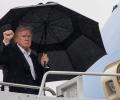
'When Prime Minister Modi met President Trump, they agreed to initiate a bilateral trade dialogue.' 'It makes sense to give these negotiations a chance.'

Experts believe it would be far-fetched to believe that Riyadh would support Pakistan militarily in any conflict with India, which has robust strategic and economic relations with Saudi Arabia.
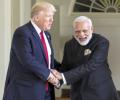
The trade deal, officials say, can lead to an effective trading bloc against the China-led Regional Comprehensive Economic Partnership.
'But I don't think the government is in a great hurry to sign the BTA.'

Had India agreed to join the trade pact, Indian markets would have been flooded with cheap Chinese products.

External Affairs Minister S Jaishankar on Friday met Akie Abe, the wife of Japan's late Prime Minister Shinzo Abe and recalled the late premier's invaluable contribution to the advancement of India-Japan relations.

Surjewala said the party's 10-day agitation was formalised at a meeting in which Rahul Gandhi participated in, but neither he nor Sonia Gandhi would be participating in the state and district level programmes.
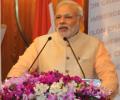
There were concerns in Sri Lanka about the huge trade imbalance.
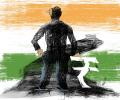
The employment situation remains dire. Whatever can be done to promote greater low-skill employment should be pursued aggressively, advises former chief economic adviser Shankar Acharya.

The way to deal with a bully is to resist bullying, because submission in the first instance only invites even more overbearing demands in future. What may seem like a small price to pay now will lead to a much higher price later, warns former foreign secretary Shyam Saran.

Addressing the MPs in Parliament, he favoured early conclusion of the Comprehensive Economic Partnership Agreement to push economic relations and raise the volume of bilateral trade to $20 billion in the next three years.
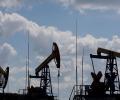
An influential US lawmaker claims his visit to India helped catalyze "early signals" that New Delhi may reduce its imports of Russian oil, a step he described as "meaningful" in weakening Moscow's ability to fund its war in Ukraine.
Keen to forge all-weather ties with India, Sri Lankan President Mahinda Rajapaksa has lauded the developmental work undertaken by the country in the war-ravaged northern region and vowed not to allow his nation's soil to be used against it.
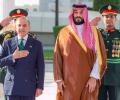
'Saudi-Pak defence pact is to anchor the defence and security of Saudi Arabia and not Pakistan, per se, with Islamabad being the junior partner.'

The BJP's effort comes in the wake of Commerce and Industry Minister Piyush Goyal set to attend the eighth RCEP ministerial meeting in Bangkok from October 10 to 12.

Prime Minister Narendra Modi condemned the violation of Qatar's sovereignty following Israeli air strikes on Doha, targeting Hamas leaders. He conveyed India's deep concern to the Emir of Qatar and reiterated support for peace and stability in the region.

Moon Jae-in's visit will play a crucial role in exploring complementarities between India's Act East policy and South Korea's New Southern policy, says Dr Rahul Mishra.
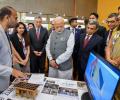
He said that India will work with Singapore to bring the Regional Comprehensive Economic Partnership to early conclusion. He also said the India-Singapore Comprehensive Economic Cooperation Agreement has been reviewed and the two sides will work to further upgrade it.
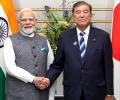
Prime Minister Shigeru Ishiba's sudden resignation after only a year in office has thrown Japan into political turmoil, raising doubts about how the country will handle economic and regional challenges, observes Dr Rajaram Panda.

Aiming to give fillip to India's Look East policy, Prime Minister Manmohan Singh is expected to announce new initiatives to take forward ties with the ASEAN by setting up a mission and appointing an ambassador for the 10-member grouping.
Risk aversion is currently a dominant depressant to economic recovery, points out Shankar Acharya, former chief economic advisor to the Government of India.

Sources said China was forcefully pushing for inking the deal during the RCEP summit later in the day, which was seen as an attempt to counter-balance the impact of its lingering trade war with the US as well as to project the region's economic might to the West.

Indian firms feared they would lose business if US ratified the Trans-Pacific Partnership agreement with 11 other countries.

India, Jaishankar said, is a "prisoner of its past image" and must get over it.

For India to reach its ambiguous economic growth targets, it needs to be integrated into global trade pacts.
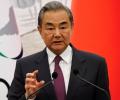
China on Tuesday called for a 'comprehensive and lasting ceasefire' between India and Pakistan, urging both countries to properly handle their differences through dialogue.
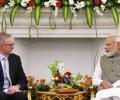
The matter came up for discussion during their wide-ranging dialogue that was aimed at expanding overall ties.
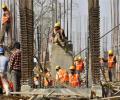
"We see the Indian economy rebounding from our projected 6.1 per cent growth this fiscal year to something like 7 per cent in the next fiscal year (2020). We see the factors that will support growth, including monetary policy stimulus, working their way through the pipeline," Jonathan Ostry, Deputy Director, Asia Pacific Department at the IMF, told reporters.

Prime Minister Narendra Modi on Thursday asserted that the world community must reject any linkage between religion and terrorism while formulating a "genuinely international" partnership in the fight against all forms of terror acts.
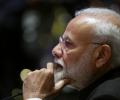
According to the industry body, the 16-member RCEP has the potential to become one of the largest and economically dynamic trading blocs of the world, even bigger than the European Union.
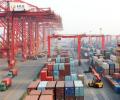
Chinese manufacturers are re-routing their products through the markets of other countries that India has Free Trade Agreements with.

The road will help in transportation of goods and further development of SMEs in North East India
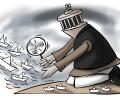
Panagariya also pointed out that COVID-19 pandemic may lead to integration of global labour market.

The visit of Park Geun-Hye to India, though a symbolic one, will certainly give a further impetus to the strategic partnership between the two countries says Rup Narayan Das.

The Singapore Minister applauded Prime Minister Modi's effort to make India the manufacturing hub of the world.

The prime minister was speaking at an event to mark golden jubilee of the Aditya Birla Group's presence in Thailand.
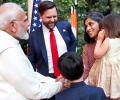
Prime Minister Narendra Modi and US Vice President JD Vance have expressed satisfaction with the progress made in negotiations for a bilateral trade agreement. The two leaders met in New Delhi and discussed a range of bilateral issues, including cooperation in energy, defense, strategic technologies, and other areas. They also exchanged views on regional and global issues of mutual interest.

'The touchstone is reciprocity which will be applied to friends and foes alike.' 'It will be a bitter pill to swallow.'

Global confidence in India has been restored, says Modi.
.jpg)
President Pranab Mukherjee has sought to counter criticism against the economic stimulus provided when he was the Finance Minister in 2009 and maintained that economy under him registered high growth rates.
